Christian Brothers and Edmund Rice
Blessed Edmund Rice, founder of the Christian Brothers was born in Callan, County Kilkenny, Ireland, in 1762.
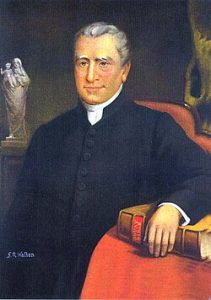
Edmund Rice
As a community we follow the example given to us by Blessed Edmund Rice. Edmund Rice was an Irish man of the 18th and 19th Century who had the dream of creating a better world for poor young people through religion and education. Born into a prosperous family, Edmund from an early age began to see a great contrast between the rich and poor. Given a good education, Edmund became a businessman in Waterford and eventually married Mary Elliot in 1785. They were blessed in 1789 when Mary fell pregnant with a daughter but unfortunately died from complications of childbirth.
These events changed Edmund. He joined a small prayer group of men and felt a strong calling to found an Order which would uplift and educate poor boys in Ireland. Edmund began living as a lay brother, sharing in the Eucharist daily and incorporating regular prayer and Bible reflection into his day. He worked closely with the Presentation Sisters and in 1822 his Order became a reality and was known as the Brothers of the Christian Schools or the Christian Brothers. Despite many challenges, Edmund established many Christian Brothers Schools catering for over 5,500 boys, free of charge by 1825. His compassion and love for the poor is a legacy taken up by Christian Brothers and their communities who have continued the vision of Edmund Rice by addressing the social and political realities of their world.
His legacy
Edmund is honoured as the founder of both the Christian Brothers and the Presentation Brothers. For more than two centuries, many have been and continue to be attracted by his vision and generosity. The mission continues today on all five continents through the ministry of Christian Brothers and laity called to serve in this vocation of Catholic Education.
The Christian Brothers came to Australia – first of all, to Sydney – in 1843, at the invitation of Archbishop Polding, but left in 1848.
They arrived in Melbourne in 1868 at the invitation of Bishop James Goold. Within thirty-five years, the remarkable Brother Patrick Ambrose Treacy had responded to invitations from various Bishops to establish schools in the Dioceses of Brisbane, Sydney, Adelaide, Dunedin and Perth. The task of the Brothers in Australia, as mandated by the Bishops, was the evangelisation of the mainly poor, mainly Irish, Catholic families of the colonies.
The gift to Australian Catholic education since 1868 has been profound. The ministry of the Christian Brothers and their co-workers is active in all States and Territories of Australia and continues to be expressed in multiple forms.
At the beginning of the 21st century in Australia, there is a continuing need for Catholic schools in the Edmund Rice tradition to reflect on their purpose and role. This is borne out by the complexity of the modern world and the challenges confronting young people in their search for meaning. All members of these schools are called by way of their vocation to be committed to reflect deeply on engrained practices and issues relevant to spirituality. They are called to provide education that is transformational and liberating within the reign of God for the world.
A school conducted in the Edmund Rice tradition
- offers a distinctive Catholic educational philosophy
- provides a curriculum attentive to the needs of each person
- nurtures and encourages the spirituality of each person
- lives and grows as a faith-sharing community by fostering a personal relationship with God through Jesus Christ
- develops a culture of good relationships, which evidence respect, community, hospitality, nurture, humour, care and justice
- acknowledges the dignity of all its members, each formed in the image of God
- promotes service of others, by way of significant learning experiences
- stands in solidarity with those who are powerless and marginalised
- fosters in its members the mind and heart of Edmund, who acted with compassion
- acknowledges the traditional relationship of indigenous peoples with the land
- actively encourages all its members – teachers, staff and students – to reflect on the contemporary world in the light of the Gospel.